Symbols of Self Awareness Old Fashioned Mirror Frames
Symbols in art: What'southward there in the mirror?
Once, man conquered his fear of his reflection in water — and wanted the phantom to linger on. He tried different media, such every bit bowls of water or polished surfaces, experimented with tin and other materials. Equally a result of centuries of trial and error, nosotros tin now see ourselves at whatever fourth dimension around the clock, and the mirror no longer seems a mysterious and sinister object, only quite an ordinary and everyday one. However, in art, mirrors still have a busy and glittering existence. Then, why are they favoured by artists?
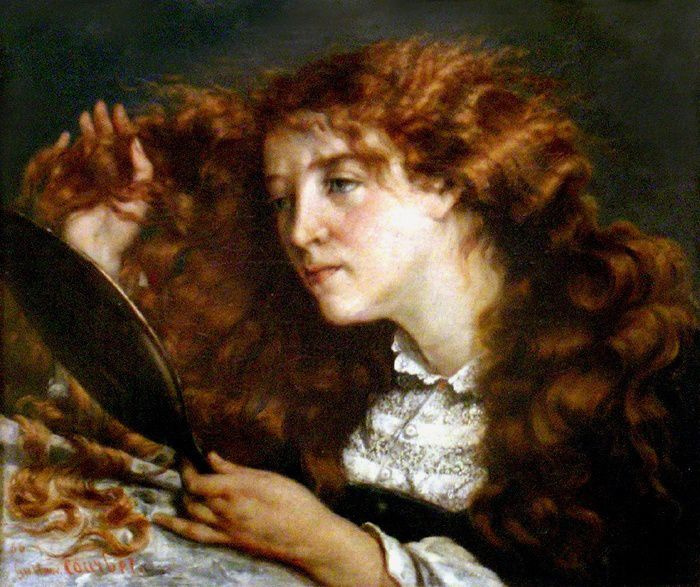

A curious fact: everyone knows the Venus symbol, but few know that the picture signifying femininity is derived from a pictorial representation of the hand mirror popular in the classical world. In that location are some indications that the sign of Venus's looking-drinking glass is traceable to the Ankh, the Ancient Egyptian symbol of life, understood equally the key of life, the symbol of eternity.
And so, there are reasonable grounds to believe that artists practical information technology to express their adoration for the voluptuousness of the body that promised the delights of love and granted immortality through providing future generations.
The sombre mediaeval glance
In the Dark Ages, when Europe looked into the mirror, it was an apprehensive look.
Indeed, is it any good when lay people, instead of praying, go along staring at themselves? Well, pride feeds best on self-admiration. What is more than, pastime like this can make women (and men, as well) desire something quite far from pure and spiritual. So, the Church and the authorities tried to curb their flock's demands. Thus, they insisted that the mirror was zero else, but a mere luxury, a companion of vanity and narcissism, and preached that, if misused, it could make a person mad. In categorical terms, the Church diabolised mirrors and demonised their owners. Those who experimented with mirrors were defendant of sorcery. A general belief was that reflections in some surfaces could cleave not merely the body and the heart, only the mind and will as well.
But is there a lady that would miss a adventure to cast a glance at herself? That is why information technology became admittedly necessary to popularise the moral virtues, thus setting the careless lovely creatures on the correct pass. And then, for a long fourth dimension, allegoric subjects took their identify in the history of painting.

Bellini portrayed a wise girl who averted her face from the mirror: the devil was looking out of it!

Didactic illustrations were a task for a lot of painters. For example, Albrecht Dürer's educatee Hans Baldung Grien (c. 1484—1545) showed the brevity of time: a woman with a mirror and an hourglass, in the company of Death, was a popular motif.

No intimidation, though, could terminate the triumphant progress of mirrors. Unlike in size and shape, they found their manner into grand parlours and humble abodes. Even ironic or moralising paintings failed to discourage people from feasting their eyes upon their reflections.
No wonder this object was a must in pictures painted in the genre vanitas ('vanity') — there it reminded of the brevity, transience, impermanence of earthly pleasures. And this endured through the centuries.

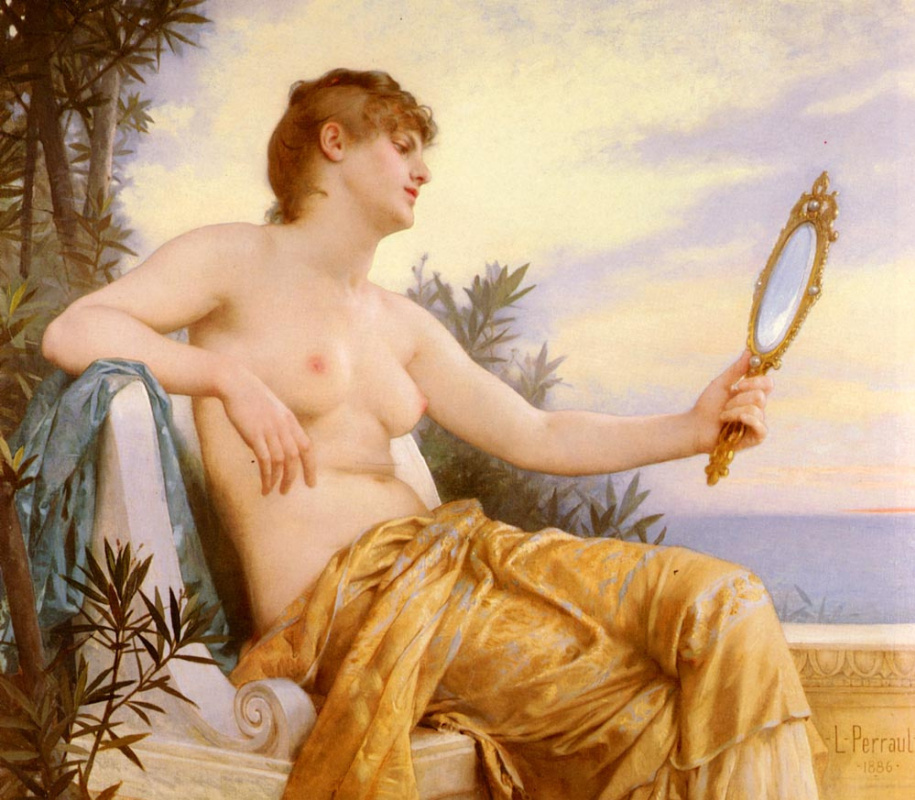
One of the best-known examples of featuring the mirror as a symbol is Jan van Eyck'due south The Arnolfini Portrait (1434). Art historians differ in their opinions well-nigh its part in the state of affairs depicted, but nosotros prefer to think that the mirror is God's all-seeing Middle, and the characters in the moving picture are taking a vow of fidelity in front of it. A hint to this understanding is the that is composed of medallions showing some episodes of Christ's life (the Crucifixion, the Procession to Calvary, the Descent from the Cross, and the Resurrection).
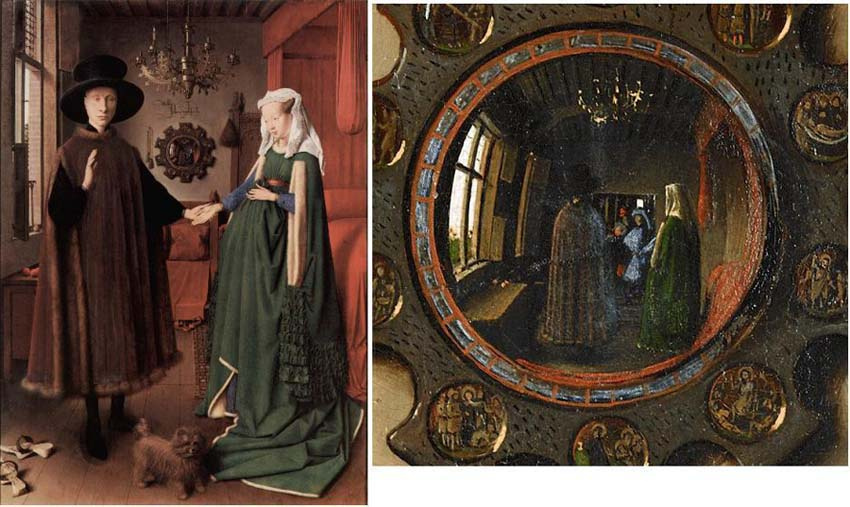

Though in those days, a mirror was an allegory of women's vanity, a candle it reflected represented the flame of faith shining upon the young adult female.
Georges de La Tour. The Penitent Magdalene.1638—1643
'And here is mirror mine — yard take this gift, o Cypris!'
A woman contemplating herself in a mirror for hours is sure to be of no virtue. And so, for a long time, this attribute of women'south dearest life was branded as 'an accomplice to licentiousness.' Could information technology be a mere coincidence that the leading manufacturer of mirrors was Venice, the urban center notorious for its courtesans!
So, in the early , none other than Venus was drawn from non-existence to assist protect the reputation of her favourite object. Though called Foam-Arisen, she came not on the crest of a wave, but fell from the sky. She entered iconography as a planet represented in the course of a goddess looking in the fatal glass.
At that fourth dimension, nudity in art was strictly prohibited, and the disobedient ones could hands have constitute themselves burnt at the stake. Even so, the public's growing involvement in classical civilisation allowed artists to 'strip' women. That is how various subjects were introduced that enriched art history with charming images. 1 of those was Jan Gossaert'south Venus.
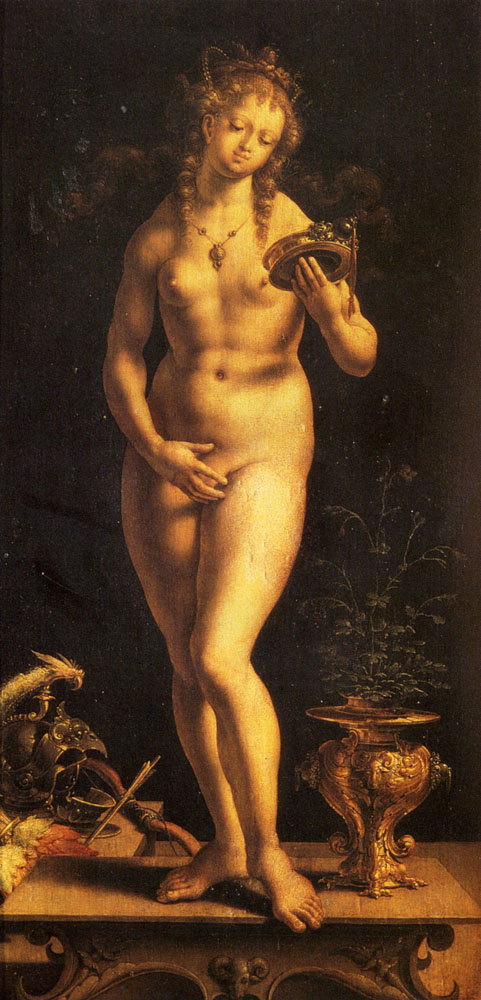

Perchance, it is the mirror that makes an attentive viewer experience some sort of discord comparing the model'due south beautiful body and the simplicity of her reflection.
A mirror cannot lie (especially a crooked one)
A common conception of the eighteenth century was that kleptomaniacal mirrors were objects revealing a person's truthful nature. Thus, the mirror, in man culture, started beingness a symbol of self-discovery.
It is possible that this theory was given rise to by anamorphic mirrors — shiftable mirror-similar canvases invented in the start half of the seventeenth century. In information technology, optical displacement made a cluttered picture assemble into an easily perceived image. The effect was fifty-fifty interpreted in a securely philosophical way, every bit the truth revealed through mirrors.
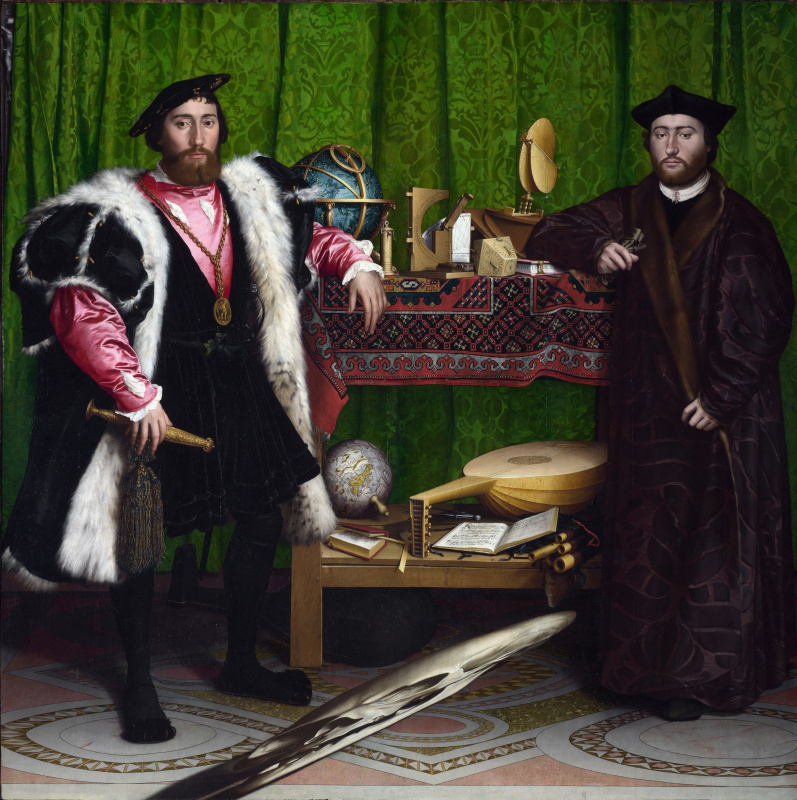
In Hans Holbein the Younger'southward motion-picture show, the foreign object in the foreground, when seen at a certain angle, appears to be a skull (this symbol of expiry was then popular in iconography).
A picture in the film
The 16th century was the period of discoveries, inventions, and the extraordinary progress of scientific discipline. Man became both the creator and the most important object of fine art. Human figures, equally they were part of the world, were now depicted in most various poses, gestures, movements. Artists started using mirrors enthusiastically — to aggrandize a composition, to bear witness things that the viewers wouldn't take seen otherwise.
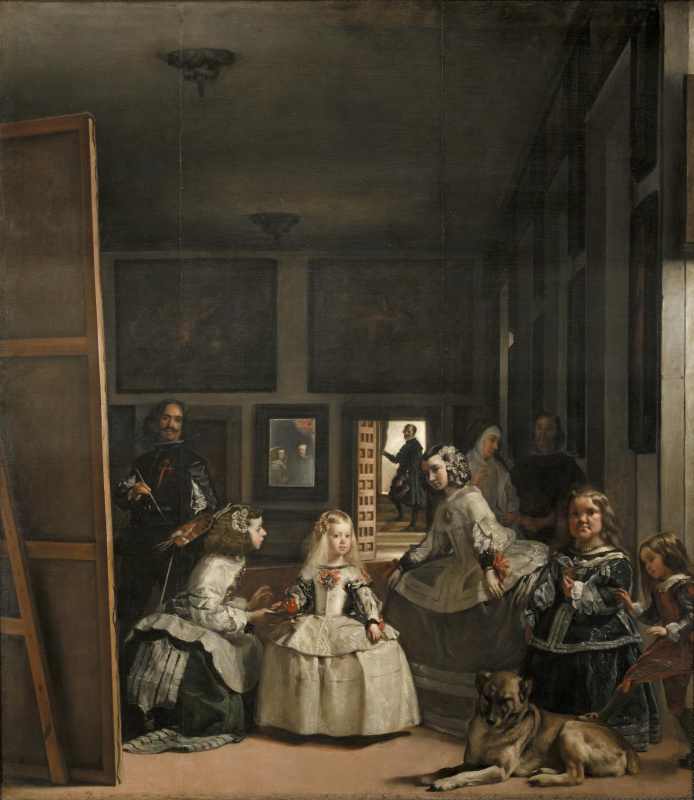
Velázquez had x mirrors in his studio, though in his days, they cost quite a fortune. Once asked why he needed so many of them, he said that the mirrors were his assistants, almost his apprentices. Indeed, a reflection is a film in a way, except that it but exists for a divide second.
In the 19th century, artists were no longer content with just making their characters look natural and existent — their models now had feelings, hopes, and doubts. To this end, the mirror came in most handy.
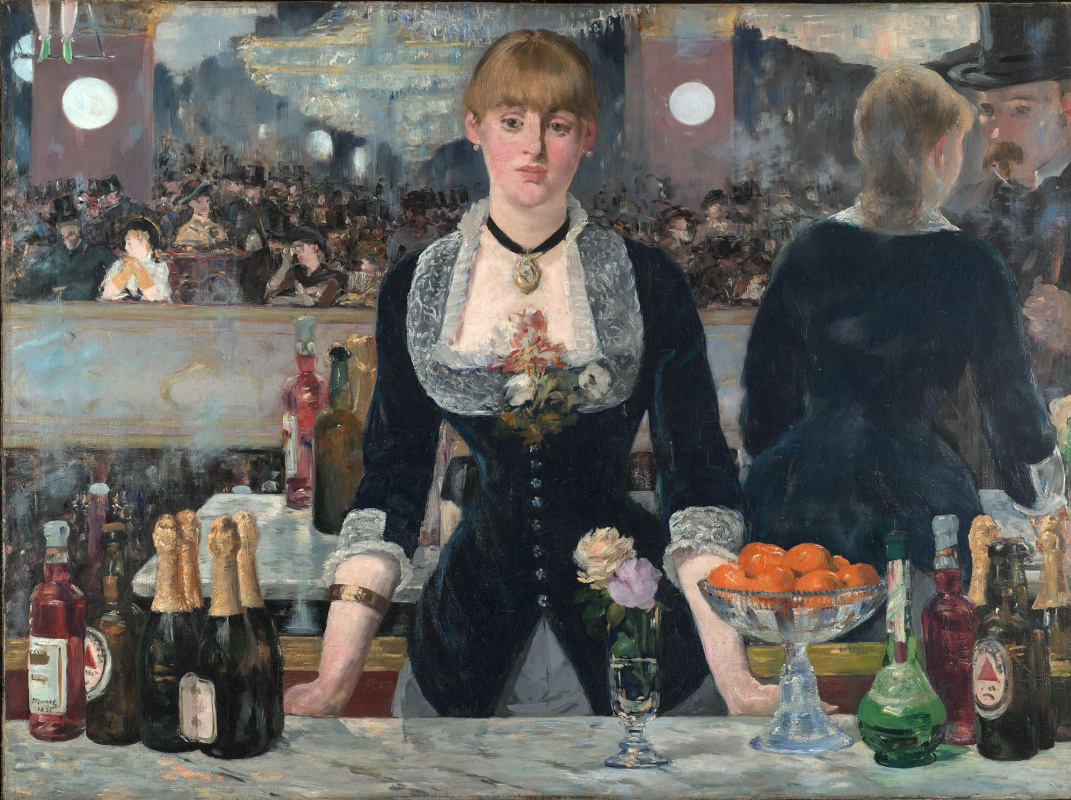
Note that the barmaid's posture in the reflection is not the same equally that in real life. Even the positions of the bottles on the marble counter are mirrored in a different style. The real and the reflected are inconsistent with one some other. Perhaps, the real girl is now musing on the conversation she had a few minutes ago, and the picture show in the mirror shows the events of those past minutes.
'Tout chiliad'appelle et g'enchaîne à la chair lumineuse Que k'oppose des eaux la paix vertigineuse!'
'Everything calls me and enchains me to the luminous flesh, what is opposite me in the vertiginous peace of the waters!' — these are the words that Paul Valéry's Narcissus addressed his reflection that he had fallen in love with.
The myth, which belongs to the nearly popular ones, throughout the centuries, has been interpreted in numerous ways. In the , Narcissus was fifty-fifty proclaimed the inventor of the art of painting!
Particularly pop the myth became in Modernist art that was highly interested in how the hidden effects on the deed of creation. For Modernists, water was not a mere reflection of the fellow'south beautiful exterior, but rather a symbol of what he had deep in his soul. Peering into his mirrored epitome, Narcissus was trying to gain insight into his own subliminal consciousness.

The poetry of everydayness
At the finish of the 18th century, the cheval glass was invented. That well-proportioned, portable mirror soon became an indispensable commodity of daily use for every self-respecting lady. And thus, artists got a blank check to poeticise a humdrum life and the commonest interiors.

Pierre Bonnard stuck to depicting the same indoor environment. On the ane hand, the indoor objects and furnishings he featured in his canvases were part of the 'looking-glass world,' on the other paw, they were included into the real environment, where the viewer was standing in front of the picture.
'Behind my shoulder, in the looking-glass, I saw so often something not chosen for…'
In the heathen Rus (as well as in other lands), the glass of the mirror was a border betwixt the two worlds, the material and the transcendental ones. Even now, it is still considered that destroying this border — breaking the looking-glass — spells disaster. Russian Old Ritualists regarded mirrors as a gift of hell and never had them in their homes. Looking into a mirror meant committing a sin. The conventionalities held till the end of the 17th century. And then, Peter the Great took power, and at present everyone was free to admire their mirror image.

This is the simply folk subject area Karl Bryullov ever painted. In this scene, the mirror is an instrument for Christmas divination. The heroine is peering, both appallingly and hopefully, into the dark shadows backside her.
Other worlds
The 20th century was the time when the mirror resumed beingness regarded as something more than an ordinary everyday object. Once more, it was ascribed the mystic power of showing anything it would similar to and taking a person into another reality. For example, the Expressionist artists took a liking to the of vanitas, so they started showing the mirror as a mendacious structure that obscured the existent nature of things.

As the mirror symbolises truthfulness, it gave Delvaux reasons to believe: whatsoever attire a lady wears, her existent self comes out, nonetheless.

In Magritte'south work, a reflection no longer depends on what it is caused past, and starts conflicting — not with the trunk, but with the mirror and with the laws of physics.
Michelangelo Pistoletto concluded his dialogue with a reflection in a curious way. Without a slightest hesitation, he smashed the wall mirrors in his installation limerick Twenty-Two Less Ii at the vernissage of the 53rd Venice Biennale. That was the creative person'southward protest confronting the practice of totally repeating the images. Still, we withal feel like having a trip nigh the worlds backside the looking-glass in pictures by different artists.
Championship illustration: Gustave Courbet. Jo, the Beautiful Irishwoman. 1865, Metropolitan Museum of Fine art, New York
Text by: Yelena Nastyuk
0 Response to "Symbols of Self Awareness Old Fashioned Mirror Frames"
Post a Comment